Most of what you read about building an app with AI is either hype or a toy demo. This is neither. This is the story of a real app, used by real families, built by one person directing AI in the gaps between client work. I am sharing it because it is the clearest picture I can give you of what AI development actually looks like in 2026, including the part where I threw away a working version and the part where an AI security review caught a real bug before launch.
The Problem: Group Text Chaos
Every youth theatre has the same communication problem. Rehearsal changes live in one group text. Costume notes live in another. Volunteer sign-ups sit in a Facebook group half the parents never joined. Somebody always misses the message, and it is usually the family that needed it most.
Accolade, the community theatre my wife helps run, already had something most theatres do not. Over the past year I built them a full platform: auditions, casting, registration, ticketing, camps, volunteers. But day-to-day communication still leaked out into texts and email threads, because the platform had no place for it.
The obvious fix was to adopt an app like Band or GroupMe. We looked hard at that. The problem is that a third-party app knows nothing about your organization. It does not know which families are enrolled in which show. It cannot enforce your child-safety rules. It is one more account, one more feed of ads, and one more place where a kid can end up in a conversation nobody can see.
So I built our own. It is called Accolade Backstage.
What We Built
Backstage is a private community app that installs on your phone like any other app. When a family enrolls in a show, they are automatically in that show's group. No invite links, no roster spreadsheets. Staff post announcements, pin the important ones, and share photos. Families comment and react. There are community groups too, for parents, set builders, and directors, with staff approval on who gets in.
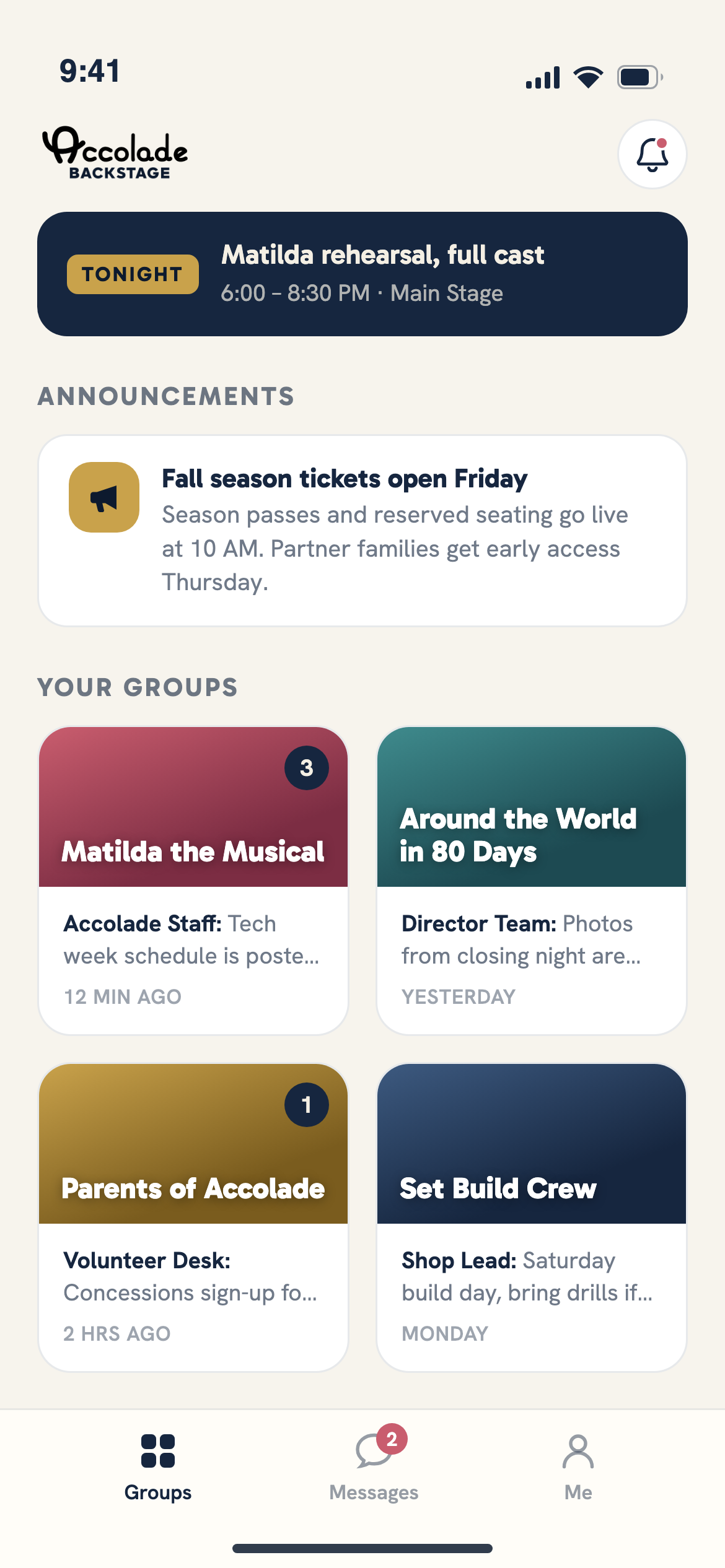
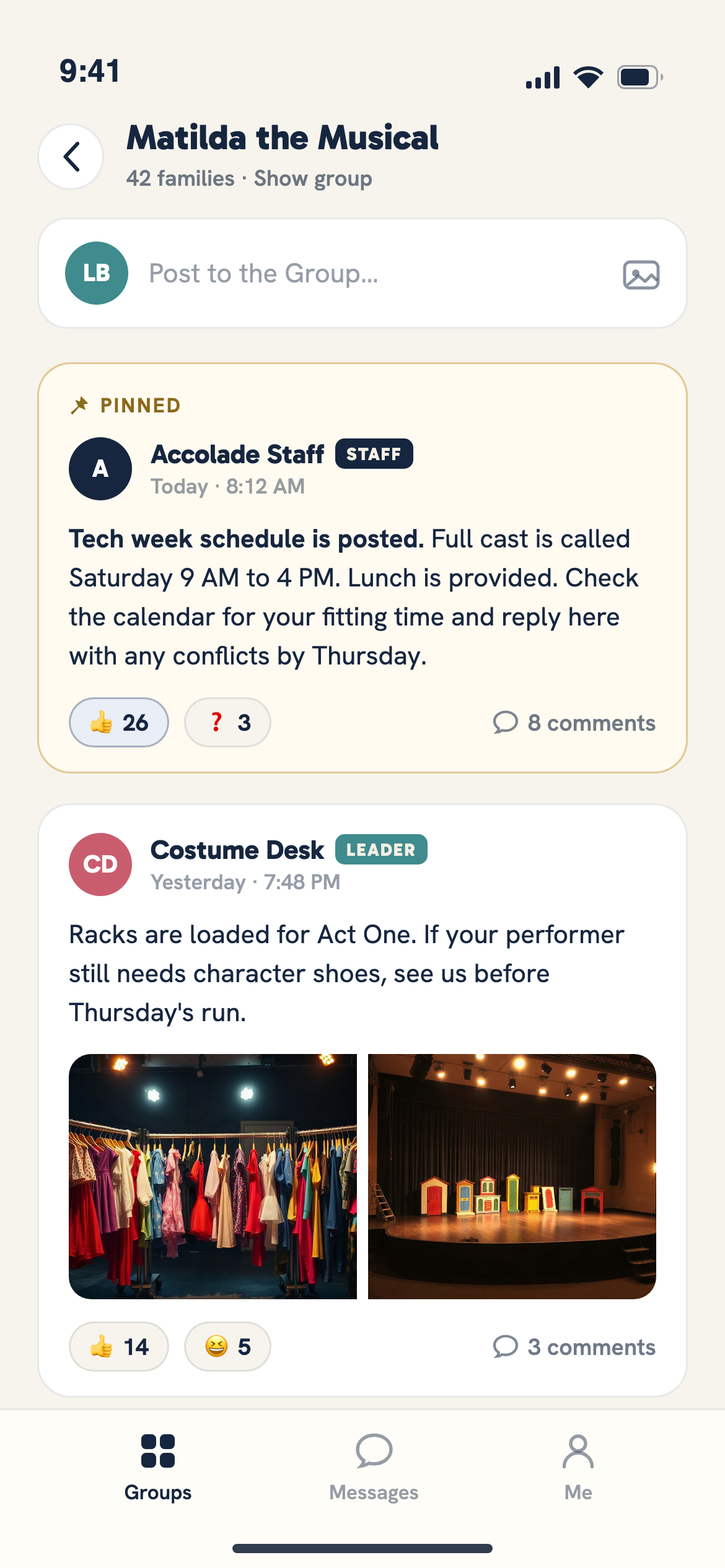
Notifications were a deliberate decision. Posts send a push notification to your phone and nothing else. No email. Parents are drowning in email, and the fastest way to get your announcements ignored is to send more of it.
The strictest thinking went into kids. Children have no access unless their parent turns it on, per child. Kids can never message other kids, period. Any conversation that includes a child automatically includes that child's parents. And designated admins can audit conversations. Those rules are not settings someone can forget to check. They are enforced in the database itself, so no bug in a screen can leak around them.
The Version I Threw Away
My first version was a chat app. It worked. Real-time messages, channels per show, image sharing. I showed it to my wife, who actually runs programs like this every day, and she said no. Chat scrolls the important things away. A theatre needs a bulletin board, not a group text. Posts that stay put, with reactions and comments underneath.
Two years ago that feedback would have hurt, because it would have meant weeks of rework. Instead I shelved the chat app and had a working post-based feed the next day. That is the part of building an app with AI that people underestimate. It is not just that you build faster. It is that being wrong gets cheap, so you can afford to listen to the person with taste.
This is also the difference between AI tools and an AI strategy. The value is not that the machine has good ideas. The value is that your ideas, and your corrections, get implemented at a speed that used to be impossible.
How Building an App With AI Actually Works
I built Backstage with Claude Code, Anthropic's AI coding tool. My role was decisions, not typing. I decided one group per show instead of separate cast and crew groups. I decided join requests need staff approval. I decided kids are off by default. Claude turned those decisions into a database schema, security policies, and the app itself.
The rough timeline, working around my normal client load: the feed in a day. Groups, the installable app, and push notifications in another day. Private messaging with all the child-safety rules in an evening.
Then I did something I would tell any business to do with AI-written software. I had a separate AI agent attack it. I ran a security review where one agent hunted for vulnerabilities and another tried to prove each finding wrong, so I only chased real problems. It confirmed a genuine authorization bypass in the messaging system. Fixed before a single family ever touched it.
That loop, build fast and then verify adversarially, is the whole game with AI development. Speed without verification is how you ship something you regret.
What This Means for Your Business
A private, installable community app with automatic membership, photo sharing, push notifications, and database-enforced child safety used to be a six-figure project with a development team. This was one person, directing AI, in the gaps between client work.
Your business probably does not need a theatre app. But it almost certainly has its own version of group text chaos: a process held together by memory, spreadsheets, and crossed fingers. The point of this story is that the fix is now within reach for a small business budget, if someone with judgment is directing the work. That is what AI consulting actually looks like when it goes past the buzzwords: real decisions, real software, real verification.
Ready to Fix Your Own Communication Mess?
If your organization runs on group texts and hope, let's talk about what a purpose-built tool would take. Book a call at lesbrowndesign.com.